

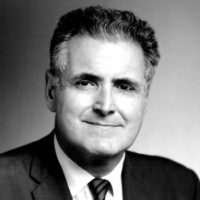
Albert Lasker
Clinical Medical Research Award

Award Description

Porter Warren Anderson, Jr. and David Smith
For groundbreaking work and bold, visionary and imaginative leadership in the development and commercialization of the Hemophilus influenzae type b vaccine and bringing the vaccine to market, leading to the eradication of Hemophilus influenzae type b, typhoid, and pneumococcus.

It is rare in medicine that researchers who conduct groundbreaking work in the laboratory are able to play a central role in bringing their discovery to commercial production and distribution for the benefit of millions of people around the globe. Such is the case for Porter Warren Anderson, a microbiologist, and David Hamilton Smith, a specialist in pediatric infectious diseases, who pioneered in developing the polysaccharide-protein conjugated vaccine for Hemophilus influenzae type b (Hib) and then created a mechanism for bringing it to market.

In 1968, in an investigation that was independent of the work of Robbins and Schneerson, the interdisciplinary team of Drs. Smith and Anderson began their probe of the biology and epidemiology of bacterial drug resistance factors and the pathogenesis and prevention of the diverse diseases caused by Hib, a list which includes some of the scourges of childhood illness—including bacterial meningitis and its attendant mental retardation and deafness—as well as epiglottitis, arthritis, osteomyelitis and pneumonia. In those years, it was estimated that Hib and related illnesses cost more than $2 billion each year.

In a collaboration that began at Children's Hospital Medical Center in Boston and continued at the University of Rochester, Anderson and Smith made the first polysaccharide-conjugate vaccines to be tested in adults and infants. From 1972, when their first publication on Hemophilus influenzae type b appeared in the Journal of Clinical Investigation, they were vigorous champions of efforts to develop a safe and effective vaccine, seeing it through to licensing and commercial production.

In 1983, Dr. Smith founded Praxis Biologics and under its banner, expanded the conjugate immunochemical technology he and Dr. Anderson had developed. Two years later, the U.S. Food and Drug Administration allowed Praxis to market b-CAPSA I for the protection of children age two and older against Hib—the first such pediatric vaccine cleared by the FDA and recommended for use in all children. In 1988, Praxis received approval to market its second generation Hib conjugate vaccine (HibTITER) for children 18 months and older. And in 1990, the FDA cleared HibTITER for use in infants starting at two months.

By 1989, Praxis had the largest number of new vaccines in clinical trials of any U .S. company and one of the finest manufacturing facilities in North America. To expand its marketing and distribution capacities, Praxis merged with American Cyanamid Corporation, where Dr. Smith served as Chairman and Scientific Officer of the new Lederle-Praxis vaccine unit until 1990.

The collaboration of Drs. Smith and Anderson presents a model of scientific partnership. Both in the laboratory and in the world of drug marketing, they are second only to the blending of their discoveries with their co-winners of this year's Albert Lasker Clinical Medical Research Award, Drs. Robbins and Schneerson. The two teams, although working on parallel but separate tracks, shared their knowledge and insights on a routine and regular basis, bringing the sum of their formidable talents to the problem of infant death and disability and finding solutions that have saved hundreds of thousands of lives and prevented much suffering the world over. That Hemophilus influenzae type b today is virtually unknown in the United States and is fast being eradicated is profound testament to their dedication and collaboration.

To Porter Warren Anderson, Jr. and David Hamilton Smith, for visionary leadership in developing and bringing the lifesaving Hemophilus influenzae type b vaccine to the world market, this 1996 Albert Lasker Clinical Research Award is given.

Rachel Schneerson and John Robbins
For groundbreaking work and bold, visionary and imaginative leadership in the development and commercialization of the Hemophilus influenzae type b vaccine and bringing the vaccine to market, leading to the eradication of Hemophilus influenzae type b, typhoid, and pneumococcus.

A few once-deadly infectious diseases—smallpox, polio, diphtheria—have virtually been eliminated from the planet. The creative work of Drs. John Robbins and Rachel Schneerson will likely add Hemophilus influenzae type b (Hib), a deadly and disabling infectious agent, to this infamous list before the turn of the century. In the U.S. alone, meningitis caused by the bacterium has been reduced by more than 98 percent to the point where most medical students now will probably not encounter patients with an infection caused by Hib.

The picture was much different prior to the advent of antibiotics against Hib, a leading cause of bacterial meningitis throughout the world and almost uniformly fatal. Antibiotics "cured" most patients but as clinicians searched further, they gradually realized the limitations of their therapy: Among those treated with antibiotics, about 30 percent were left with permanent CNS problems, including deafness and retardation. (Hib meningitis was the leading cause of acquired mental retardation in children.) Within the past decade, it was estimated that each year 13,000 children contracted Hib meningitis and an additional 7,000 had other serious infections caused by this pathogen, including epiglottitis, pneumonia, pericarditis, arthritis, and osteoarthritis.

Starting in 1968, these two scientists showed that Hib capsular polysaccharide (CP) could be prepared in a clinically acceptable form, developed a standardized quantitative assay for measuring antibodies to this antigen, estimated the protective level of these antibodies, and conducted clinical trials. Unfortunately, these initial trials established that this CP did not elicit sufficient antibodies in infants and young children—the age group with the highest incidence, mortality and morbidity caused by Hib. Recognizing the limits of CP, Drs. Schneerson and Robbins studied methods to improve its immunogenicity. Drawing on the observations of Drs. Karl Landsteiner, Oswald Avery and Walter Goebel—who in the 1920s and 1930s discovered that immunogenicity of polysaccharides could be enhanced by binding them to a protein—Drs. Robbins and Schneerson developed a clinically acceptable method of binding the Hib polysaccharide to a medically useful protein, tetanus toxoid, to form a conjugate vaccine. In sequential studies, their Hib-tetanus conjugate elicited protective levels in mice, rabbits, and young rhesus monkeys and then in human adults, children and infants. Their achievement opened the door to their and others' development of conjugate vaccines for other bacterial pathogens whose surface polysaccharide could serve as a protective antigen.

Their leadership was recognized by their appointment to an Ad Hoc Committee of the World Health Organization (with Dr. Robbins as chairman), convened to write requirements for the Hemophilus influenzae type b conjugate vaccines. Hib conjugates are now recommended for universal use in the Expanded Program on Immunization of the WHO.

Drs. Schneerson and Robbins and their colleagues extended the development of conjugate vaccines to improve the immunogenicity of the capsular polysaccharides of pneumococci, meningococci, Group B streptococci, and Escherichia coli. Their reintroduction of the forgotten Vi antigen of Salmonella typhi as a vaccine for typhoid fever turned around the field of research into enteric bacterial vaccines. The Vi is now licensed by the FDA, and the WHO has published requirements for this new vaccine. Clinical trials of Vi conjugates, designed for routine vaccination of infants, are ongoing. This group is now evaluating vaccines for non-typhoidal salmonellae, shigellae, and E. coli 0157. Recently their monocomponent toxoid vaccine for pertussis was licensed in Sweden and is now under review in this country by the FDA.

To Rachel Schneerson and John Robbins, for bold and imaginative leadership in developing polysaccharide conjugate vaccine against the Hemophilus influenzae type b, this 1996 Albert Lasker Clinical Medical Research Award is given.